

Drafting one AI feature spec took 3 days by hand in the old workflow. With a chat assistant asked for a first pass and 2 hours of checking and metric definition after, it takes part of an afternoon.
That trade is the whole story behind the jobs below.
The titles are not LinkedIn rebrands. AI-titled postings rose 173% year over year in Q1 2026, while software development postings fell 22%, according to Dice data reported by CIO Dive.
Tech postings naming an AI skill went from 15% in January 2024 to 73% in May 2026.
The ads are countable: 4,346 live U.S. postings for AI Solutions Architect and 1,827 for AI Product Manager, per Lemon.io benchmarks. The salary is not the deciding fact. The catch is.
All 11 roles are real, each with a 2026 base benchmark and one catch that rules some people in and others out.
Each comes with one artifact worth a week, not a degree. Sort them by your situation, pick one, and quote the pay as benchmarks, not offers.
Test the job with a small piece of work before you spend a year retraining for it.
The Pay Landscape at a Glance
Build and Secure the AI Stack
These first four roles sit closest to the model. You are designing, shipping, securing or training the systems everyone else builds on top of.
The pay is the strongest on the list here, and so are the technical requirements. All four expect evidence of a running system, not a course certificate.
1. AI solutions architects translate business problems into working stacks
Prompt to copy
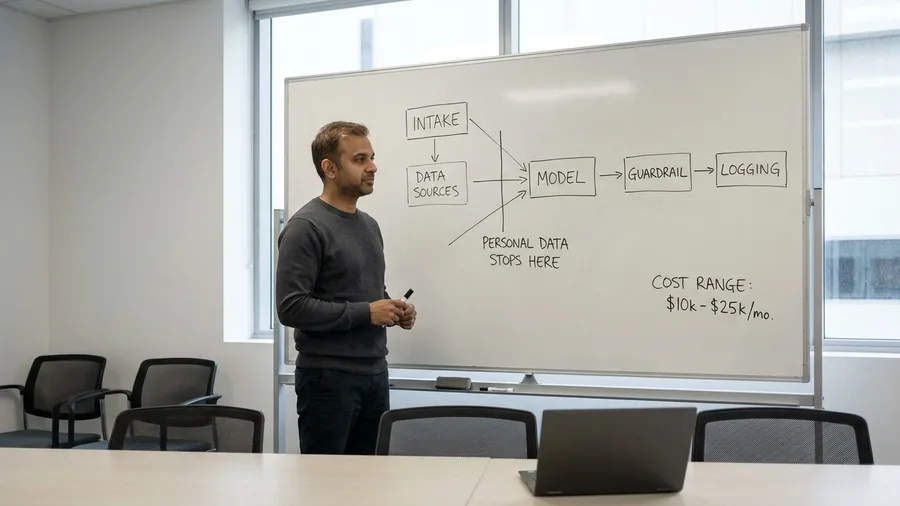
I'm drafting a reference architecture for a customer support triage bot that runs inside our existing cloud account. Draw the boxes and label the arrows: intake, data sources, the model, the guardrail layer, logging, and the handoff to a human agent. Put a hard line where customer personal data stops flowing to the model. Add an estimated monthly cost range for 20,000 tickets and list the three assumptions that most change that number. Output as a one-page diagram description I can redraw, and flag where I've guessed.
Paste that into Claude or ChatGPT and you get a labeled layout back in under a minute, with a cost band and a short assumptions list. The guesses are where the work starts, so check every number against your own cloud bill.
That is the architect's actual job. Pick the model, the data sources, the integration pattern and the cloud stack for one named deployment, not a general platform. It is the design layer between a vendor demo and something that runs.
The pay is the broadest on this list: $139,571 median base across 4,346 live U.S. ads, with 96.6% offering $100,000 or more, per 2026 Lemon.io benchmarks. The catch is that the role is customer-facing and deliberately wide.
A portfolio of fine-tuned models with no architecture story, no cost estimate and no diagram does not clear the bar. Hiring managers want the diagram, the cost line and the integration story.
So the first test is the artifact itself. Redraw the reference architecture for a support bot with labeled data, model and guardrail boxes, and a visible line for where customer data stops.
That one page, corrected by hand, answers the interview question before it is asked.
💡 Tip: Draft one reference architecture for a support bot with labeled data, model and guardrail boxes, and a line for where PII stops. That single diagram is the artifact worth keeping.
| Role | Pay benchmark | Core work | First skill to test |
|---|---|---|---|
| AI Solutions Architect | $139,571 median base (4,346 ads; 96.6% offer $100k+) | Design model, data, integration and cloud stack for one deployment | One reference architecture with a PII boundary line |
| AI Engineer | $234k average; $220k median; middle 50% $180k-$270k (3,829 listings) | Ship models into products with evals, latency and cost monitoring | End-to-end app that logs and scores every model output |
| DevSecOps Engineer | $134,101 median base (1,218 ads; 91.2% offer $100k+) | Secure AI pipelines, endpoints, secrets and monitoring | A model-serving repo with dependency and secret scans |
| Pre-training Specialist | $308k average (346 roles) | Large training runs, data pipelines and scaling laws | A reproduced small training run with loss curves written up |
| AI Product Manager | $137,032 median base (1,827 ads; 94.4% offer $100k+) | Decide which AI features ship and how to measure them | A one-page AI feature spec with metrics and failure modes |
| Chief AI Officer / Head of AI | $177,952 median base (236 ads; 85.2% offer $100k+) | Set AI deployment strategy, governance and value measurement | A dollars-and-cycle-time value case for one deployment |
| Prompt Engineer | $113,650 U.S. average (Indeed); high $175,849; Sunnyvale $142,327 | Design, test and maintain prompts and evaluation sets | 10 prompts with before-and-after test cases and a rubric |
| AI Alignment Specialist | $368k average (346 roles) | Evaluate model behavior and build methods to reduce harm | A public write-up of one safety intervention before and after |
| AI Red Team Specialist | $124,000 median, up 13% (SANS, Sept 2026) | Probe AI systems for injection, leakage and unsafe behavior | One reproducible red-team report with impact and fix |
| Red/Blue Operator | Posting-specific: ECS $160k-$205k in DC | Run and defend live AI agent workflows in production | An agent workflow map with human intervention points |
| AI Ethics Officer | $150k-$300k major tech; $100k-$180k mid-size | Policy, impact assessments, vendor review and escalation | A one-page AI use policy with banned data and triggers |
2. AI engineers ship models into products without a research background

An architecture decides which model gets deployed and where. The tedious part that follows is everything after the demo works: the bad response at 2 a.m., the call that times out, the invoice that doubles when a retry loop runs wild.
That is the AI engineer's week. No research background is required. The work is integrating models into the app, writing evaluation tests, watching failures in production and tuning the cost and latency trade-off on every call.
The pay shows it: $234k average and a $220k median, with the middle 50% between $180k and $270k, based on 3,829 listings checked in 2026.
Where to stop: when the task needs a judged answer rather than a pipeline, keep a person in the loop. Ranking which customer complaint is the angriest, or deciding whether a refund is fair, should not be handed to a model with a score attached.
The catch is that the title is broad and interviews test shipped systems. A notebook that never met a bad response, a timeout or a bill is not evidence.
Build one small app that logs every model output and scores it against a short test set, so the answer in the room is a link and a dashboard.
3. DevSecOps engineers secure the AI deployment, not just the code

What comes back is a short list of leaks: a model key printed in a log file, a test pipeline with no secret scan, a training script that pulls data over an open connection.
Shipping a model puts a reachable endpoint and a training pipeline into production. That surface is exactly what this role exists to lock down.
Paste the repository tree and the deployment notes into your assistant before you run the prompt. Ask it to name where a secret or a model key could leave the building and rank each by severity.
Prompt to copy
Review this plan for a model-serving repository. The repo holds a FastAPI inference endpoint, a training script and a CI config. List every place a secret, a model key or customer data could leak, rank each by severity, and give the one check to add to the pipeline first. Keep it to 10 lines and skip anything that needs a paid scanner.
That is the automated build-and-test pipeline developers already run, plus the access rules around it, pointed at AI.
One term to know: an API is the door a program knocks on to reach another program, and a model sitting behind that door needs the same guarding as a database.
Pay reflects that: $134,101 median base across 1,218 live U.S. ads in the 2026 Lemon.io benchmarks, 91.2% offering $100,000 or more.
The catch is the hours. On-call rotations and audit folders come with the role, and AI in the title does not remove the 2 a.m. page or the evidence a compliance review asks for.
To test yourself, add dependency scanning and secret checks to a small serving repo, then keep the pipeline output showing the failure and then the pass.
4. Pre-training specialists build the models everyone else fine-tunes

Every job that architects, ships or secures an AI system starts from a model somebody else trained.
Pre-training specialists do that first step: the large training runs that give a foundation model its general ability.
The work is data pipelines, distributed training across thousands of chips, and scaling laws.
Keeping a multi-week run alive is a real job on its own. One crash at step 40,000 can erase hours of progress, so specialists checkpoint constantly.
The 2026 AI developer salary report puts this specialization at a $308k average across 346 roles, second only to alignment here.
The catch is the pool. Only well-funded labs and a few large platforms can afford the compute behind a single run, and one experiment can run for weeks before telling you anything.
The test: reproduce a small training run and document the data, the compute and the loss curves. That write-up is what a lab manager reads.
💡 Tip: The compute bill behind one run is why the role count stays in the hundreds. Reproduce a small training run and document the data, compute and loss curves; that write-up is what a lab hiring manager reads instead of a resume line.
Lead the Product and the Prompt
These three roles sit between the model and the market. You are deciding what gets built, how it gets measured, and how language becomes a reliable output.
The technical bar is lower than the build roles, but the judgment bar is higher. Every one of these asks you to prove value, not just capability.
5. AI product managers decide which features are worth shipping

Picture a product manager who has to ship one AI feature this quarter. Four weeks go into building a summary tool, and nobody wrote down what a good summary looks like.
The old way, the team argued about wording after launch. The new way, they agree on a test set of 20 summaries first.
The AI version of this job still has no code in it. You define the user problem, write the scoring rubric before anything is built, then walk legal and engineering through the launch.
The 2026 Lemon.io benchmark puts the median base at $137,032 across 1,827 live U.S. ads, with 94.4% offering $100,000 or more.
The catch is unchanged. Product judgment still beats prompt tricks: AI shortens the drafting, not the interviews where you find out whether anyone wants the feature.
In a week, write a one-page spec with success metrics, failure modes and a rollout plan. That page is what a hiring manager reads first.
💡 Tip: Product judgment still matters more than prompt tricks. AI does not replace the discovery work of finding out whether anyone wants the feature.
6. Who gets AI first, and what it earns

They hire. The work is deciding which teams get AI first, who owns each deployment, and how the dollar return gets measured across a portfolio.
The pay leads this group. The 2026 Lemon.io benchmark gives a $177,952 median base across 236 live U.S. ads, 85.2% offering $100,000 or more. That median sits on the smallest pool on offer, so the odds, not the number, decide fit.
A product manager decides one feature. At company level, the same call repeats across every team: which deployment, which budget line, which owner. The hours go into portfolio reviews, governance sessions with legal, hiring approvals and the board deck that defends each dollar.
Budget for the retraining arithmetic before you read the salary. A director-titled seat plus one measured deployment is the realistic entry path.
A career changer with no budget authority spends a year studying and arrives with no portfolio of decisions. The ad pool says so: hundreds of roles, not thousands.
The document that counts is short. Lead one AI deployment where you already work, then record its value in dollars saved and in cycle time cut. The total: one deployment, one two-page value case, and no extra course spend.
7. The easiest job here to try before you commit

The title is shaky; the skill is not. Prompt work is already folding into product, support and engineering jobs, so treat the seat as temporary and the test-writing habit as the thing you keep.
One real selling point holds: this is the easiest role here to try before you commit.
The pay is real but the thinnest six figures here. Indeed's posting data puts the U.S. average at $113,650, with a high of $175,849 and a Sunnyvale average of $142,327.
Compare that to the $177,952 median for the strategy seat above and the gap is obvious.
The day job is unglamorous. You write a prompt, run it against a fixed set of test cases, log which ones fail, rewrite, and document the version so the same request gets the same quality six weeks later. Failure analysis takes most of the week.
The test: ten prompts, each with before-and-after test cases and a scoring rubric you wrote yourself. One week of evenings. Reviewers want proof the output measurably improved, not proof the prompt sounds clever.
Prompt Engineer: Where the Skill Goes Next
What you can test at home
- Pick two failing test cases from your set and score the rewrite
- Time one evaluation loop end to end, start to logged result
- Write a one-paragraph rubric a teammate could apply without you
- Check whether a support or product job post lists prompt work
What a prompt title does not give you
- No product ownership: you test, someone else decides
- No codebase access, so fixes stop at the prompt
- The $175,849 top sits in Sunnyvale, not remote
- A portfolio of clever prompts skips the scoring step
Test, Align, and Govern the Model
These four roles sit on the other side of the model: attacking it, defending it, measuring whether it behaves, and writing the policy that governs it.
The pay ranges are the widest on the list, from a $124,000 median in red teaming to a $368,000 average in alignment. The difference is not prestige. It is how hard the role is to fill.
8. Alignment specialists make models behave, and get paid $368k average

Prompt to copy
You are evaluating an AI assistant used to answer billing questions. Below are 20 test cases with the assistant's current answers [paste]. For each, mark whether it follows the policy that refunds over $500 need manager approval, and note any answer that invents a policy detail. Return a table with the case number, pass or fail, and a one-line reason, then count the failures.
Run it: Paste the answers into Claude or ChatGPT and send the prompt. You should get a table of 20 rows and a failure count within about a minute. Compare that count to your own manual read.
Change one thing: Add one refusal rule to the assistant and rerun. Post the before-and-after table publicly. That write-up, showing behavior moved, is the closest thing to the credential the $368k average across 346 roles asks for. Expect weeks of research depth, not days.
💡 Tip: Research-heavy and long-horizon. Many roles expect publications or strong evaluation experience, so this is the hardest entry for a working engineer without a research record.
9. AI red teams get paid to break systems before outsiders do

One reproducible red-team report on a public model: a pasted prompt that leaks a system instruction, the impact in two lines, and the fix.
By hand, building that report took about three hours of probing and note-taking. ChatGPT drafted the write-up in about 40 seconds; checking the leak still reproduced took 15 minutes. It is the interview artifact.
The job itself is probing models and AI systems for prompt injection, data leakage and unsafe behavior, then documenting fixes so someone else can close them. Adversarial tests, threat models, reproducibility notes and remediation reports for engineers who were not in the room.
The catch: finding a flaw is only half the work, and a finding nobody can reproduce is worth nothing.
Pay is the lowest median here, $124,000, up 13%, per SANS Institute's September 2026 listing. The premium appears in specific postings, like Reality Defender's AI Red Team Researcher at $155,000-$185,000 base plus equity.
The two times: about 3 hours by hand, 40 seconds for the draft, 15 minutes to verify the leak.
How to Test an AI Security Role in One Week
10. Red/blue operators run live AI defenses in production

An AI agent is software that takes a goal and carries out steps toward it on its own. Someone has to sit above those agents while they run in a live system.
Operators watch the work as it happens, step in when it drifts, and keep accuracy and continuity in production. An operator caught a formatting error and paused the run before it sent bad orders downstream.
Pay here comes from postings, not surveys. ECS advertised an AI-Focused Red Team/Blue Team Operator slot in Washington, DC, listed at $160,000 to $205,000 a year.
The daily work is watching agent runs, testing defenses, handling incidents, and writing the compliance record as each one happens.
The snag is eligibility. Many of these roles sit in defense contracting and expect a background check plus on-site days. That rules out remote-only readers for a large share of the postings.
The interview artifact is cheap: map one agent workflow and mark each point where a human must approve or stop it.
Two times: the workflow map takes about 90 minutes by hand, then 40 minutes of review with someone who knows the system.
💡 Tip: Defense and clearance-adjacent roles often require background checks and on-site presence, which rules out remote-only candidates for a large share of them. Map one agent workflow and write the intervention points; that map is the artifact.
Decode the Job Lingo
11. The title grew fast, but the authority decides the pay

Three years ago, a search for the AI ethics officer title returned about 20 companies. In 2026 it appears at more than 2,000.
The pay band is the widest on this list: $150,000 to $300,000 at major tech employers, $100,000 to $180,000 at mid-size companies. The number itself tells you which employer you are talking to.
The job writes the rules that an operator's incident notes get checked against. Day to day that means an AI use policy, impact assessments before a new system ships, vendor review, and a risk register that records each decision and who signed off.
Doing it by hand is slow. One policy draft took me three hours to assemble from a template, a legal memo and last year's vendor list. A chat assistant produced a full draft in about 40 seconds, and the review and rewrites took 50 minutes.
Authority decides whether the role is real. Without a mandate from legal or the executive team, the job shrinks to paperwork that product teams skip. The test is a one-page policy: approved uses, banned data, review triggers.
Two times: 3 hours by hand, against 40 seconds for the draft and 50 minutes of checking.
🗓️ Your First Week: From Curious to Candidate
Pick three roles
Choose from the builder, leader and guardian tracks based on your current work.
Read the live ads
Open the current postings and note the skills they repeat.
Choose one artifact
Commit to the smallest portfolio piece that proves the skill.
Build it
Spend the week producing it; use a chat assistant for drafts, not decisions.
Publish it
Put it where a hiring manager can open it in one click.
Frequently Asked Questions
Do I need a computer science degree for these roles?
Not for most of them. Solutions architect, AI product manager, prompt engineer, red team and ethics officer all interview on evidence of work, not a degree. Pre-training and alignment are the two where research experience or publications carry real weight.
Are these salaries real offers, or just listings?
They are 2026 benchmarks from job listings and salary reports, not offers. Listing ranges are often wider than what a specific candidate receives. Check current postings for the companies you are targeting before you quote a number in a negotiation.
How long does it take to move into one of these roles?
The portfolio artifact for most of them takes about a week to build. The retraining is shorter than people expect; the longer part is finding a company that is actually hiring for the role and can measure what you built.
Which role is the safest bet for a mid-career tech worker?
DevSecOps engineer and AI solutions architect have the broadest ad volume, so there are more openings to apply to. AI engineer has the highest median among build roles at $220k. Alignment pays the most but asks for a research record.
Can I do any of this remotely?
Most build, product, prompt, red team and ethics roles list remote or hybrid options. Red/blue operator postings are more often on-site and may require a background check, especially in defense-adjacent work.
Which of the 11 Fits You This Quarter
Match yourself to one of three situations. Builders should start with AI engineer and the logged, scored app; it has the highest median of the build roles at $220k.
Leaders should start with AI product manager and the one-page feature spec. Guardians should start with AI red team specialist and the reproducible report.
Every figure here is a 2026 benchmark from job listings and salary reports, not an offer. Use it to decide which artifact to build this week, then check the live postings before you apply.