
You type a question, hit enter, and read the reply. It sounds careful. Somewhere between that reply and the last model, a person wrote a perfect answer, checked someone else's, or tried to trip the model up.
That person is not an OpenAI employee. They are an independent contractor, paid by the task, often working through a data company with a dashboard and a rubric.
This article follows one answer from a contractor's screen to your chat box. You will see what the work pays, what contractors say goes on behind the dashboard, and how to keep your own conversations out of the pipeline.
By the end, you can make two deliberate choices: as a user, the setting to turn off today; as an applicant, the one condition that makes an unpaid test worth sitting.
| Platform | Best for | Typical pay | Core task |
|---|---|---|---|
| DataAnnotation | Creative writers, generalists, developers | $20–$40+ per hour | Evaluating AI responses, fact-checking, comparisons |
| Alignerr | Subject-matter experts, teachers, researchers | $25–$150 per hour | Advanced technical validation of complex model tasks |
| Outlier | STEM experts, legal analysts, coders | $20–$45 per hour | RLHF projects for large tech companies |
| Mindrift | Editors, global content writers, analysts | $15–$55 per hour | Writing data-generation prompts, checking language accuracy |
| Invisible Technologies | Structured workflows, tech-adjacent professionals | $15–$40 per hour | Fixing errors in backend logs and digital processes |
| Mercor | Specialists in law, medicine, finance, software | Varies by project; up to $500 per hour on some expert roles | Writing ideal answers, building rubrics, designing adversarial questions |
The hidden workforce is thousands of contract experts
The people behind a ChatGPT answer are mostly freelancers hired by data companies, not OpenAI staff. They are lawyers, scientists, programmers, teachers, economists and journalists working as independent contractors.
OpenAI's Project Stagecraft alone put 3,000 to 4,000 of them to work through Handshake AI. They built occupational task data for training and evaluating ChatGPT, in fields as different as agriculture, music creation and civil aviation.
Surge AI reported roughly 50,000 expert contractors with about 110 staff. Scale AI and Mercor recruit on a similar scale, so the person answering for a niche question may be a specialist who knows the field well.
That is the mechanism the article traces: the answer arrives fast, but a contractor wrote the ideal response behind it.
The work is grading, writing, and breaking models
A contractor's day is not labeling images. The main tasks are writing the ideal answer to a prompt, writing the rubric that grades an answer, and designing questions meant to make a model fail.
Platform work adds its own flavors. DataAnnotation-style work includes fact-checking claims and writing side-by-side comparisons of two responses. Alignerr-style work includes advanced technical validation, where a specialist checks whether a complex task was handled correctly.
It is repetitive and tightly specified, and it is judged on accuracy rather than creativity. A civil aviation task may be one narrow prompt with a fixed rubric attached. Pressing the open-ended creative part just costs points.
That labor is how the model starts sounding careful on the next try. The rubric, and the hostile question someone wrote by hand, become the standard the next answer is measured against when it reaches your chat.
From applicant to paid contractor: the typical path
Hiring starts with an unpaid assessment test

Accuracy is testing, then the gate. Most AI-training platforms require an unpaid assessment before they open paid dashboards, so nobody reaches a paid queue without proving they can match the rubric first.
Your score on that test sets your starting hourly pay rate. One test, taken once, fixes both whether you get in and what you earn at first.
Mercor screens applicants with an automated AI interview, which sorts experts into its network quickly but narrows the process at the same time.
A strong score is the lever that moves you to a better rate and better queues. The unpaid test is the first cost of entry, and no platform pays for that hour.
Pay runs from entry-level to specialist rates
The test score decides how far up the ladder an applicant can climb, and the unpaid hours spent earning it never appear in the rate. The advertised figure applies only to tasks the contractor can actually qualify for.
ZipRecruiter put average entry-level remote AI trainer pay at $24.74 per hour as of Oct 4, 2026, with most workers earning between $18.75 and $26.44. That is the bottom of the ladder, and most applicants start there.
Platform ranges in 2026 spread wide: DataAnnotation at $20 to $40+ per hour, Outlier at $20 to $45, Mindrift at $15 to $55, Invisible at $15 to $40, and Alignerr at $25 to $150.
The spread comes from the work attached to each platform, not from luck.
One Stagecraft contractor said freelancers were paid a minimum of $50 per hour, and Handshake's site showed other expert contract roles paying up to $500 per hour. Those are specialist queues with narrow entry.
General writing and checking sit in the $20s. Alignerr's advanced technical validation reaches $150, so the rate follows the qualification, not the hours alone.
AI-training work — At a Glance
💰 Entry-level average
$24.74 per hour
📊 Typical range
$18.75–$26.44
🧪 Unpaid test
Required by most platforms
⏱️ Test sets your rate
Yes, via accuracy score
🎯 Highest bands
Specialists with verifiable credentials
Reality
The rate you see advertised is often the ceiling, not the starting point.
Every training answer can pass through several human reviews
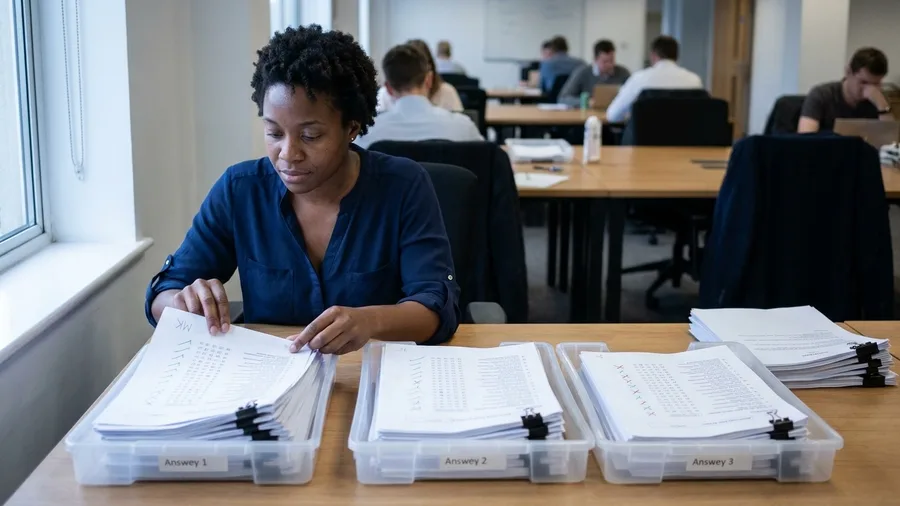
A contractor's answer does not go straight to a model. It goes through a chain, and the chain is run by the platforms rather than the person who wrote the answer.
For Project Stagecraft, the data passed two review rounds at Handshake AI. A third round of review happened at OpenAI. Each layer is a separate set of eyes and a separate handoff.
Those handoffs add delay. A submitted task can sit for days between the vendor's second check and the builder's final one, which is one reason pay does not arrive the moment work is approved.
Layered checking is built to catch bad examples before they shape the next model. It is not a guarantee that the data comes out clean. A mistake both reviewers miss still gets used.
The chain in short: contractor writes it, vendor checks it twice, OpenAI checks it a third time, then it is used.
For the contractor, that means the work is not done when the task is submitted. For the model, it means the answer it learns from has been read by several people before it counts.
⚠️ COMMON MISTAKE
Don't assume a platform's review is airtight
Three rounds of checks catch many bad examples, but OpenAI has acknowledged its filtering can let sensitive data through. Review is a process, not a guarantee.
Some contractors describe surveillance and control

Some of the people inside the review chain say the platform controls more than the review. A lawsuit in a Texas federal court, White v. Mercor.io Corp., lays out that claim about Mercor and its experts.
The case was filed as a proposed class action. It alleges Mercor treated 30,000 experts as independent contractors when they should have been employees. The proposed group includes physicians, attorneys, bankers and software engineers.
The filing also alleges the company set the experts' hours and their weekly availability. It says a surveillance app was mandatory and watched their computer screens. And it says Mercor set the pay rates and paid nothing for work done outside the tracking app.
None of this has been proven. These are allegations, and Mercor has not been found liable. Read them as claims to check, not verdicts.
Before the first task: ask whether screen tracking is required, and how unpaid work is handled. A straight answer now costs nothing. Chasing a missing payment later costs hours you cannot bill.
Terms to get in writing before the first task
Get this confirmed
- Whether the entry test is paid or unpaid, and how it sets your starting rate
- Whether tracking runs all day or only during a task, and what it records
- Who assigns hours, and whether turning down a shift costs you work
- The pay rate in writing, and what triggers a change
- How unpaid prep, retries and rejected tasks are counted
Walk away if
- The test is unpaid and the pay rate stays hidden until after it
- Tracking is required but the data it captures is never described
- Scheduling is set for you but pay comes per finished task
- The posted rate drops once onboarding starts
- No written terms exist before account setup
OpenAI filters personal data before review, but mistakes happen

Possibly. The same hands on the contractor side show up on the user side: OpenAI keeps hundreds of outside workers whose job is to open real ChatGPT conversations, check the answers and rate them.
A chat you typed at your desk can end up in someone's review queue.
OpenAI says the pipeline strips personal details before any conversation reaches a person. The company also admits the filter can fail and let sensitive data slip through to a reviewer.
A filter is a process, not a promise, so treat it as one layer of protection.
That leaves the decision with you, not OpenAI. The filter belongs to their system, and their mistake can expose your text. The switch in your own settings is the part you control, and it decides whether the conversation is eligible for review at all.
Quick check: a chat you would not read aloud in a meeting is one to keep out of the training pipeline entirely.
The training switch is on by default

Change one setting. In ChatGPT, open settings and switch off the option that lets your chats improve the models. It is on by default on the free, Plus and Pro plans, so a new account starts out sharing by default until you touch it.
Checking takes about two minutes and the tool's own settings page shows the current choice. The same conversation-level concern reaches other tools. Anthropic has confirmed that people review some Claude chats, and Gemini warns that saved conversations may be read by reviewers.
No switch makes a chatbot a safe place for secrets. Keep passwords, client files and medical or financial records out of every chat window, even with sharing switched off.
Two minutes now: flip the switch, then look again after any plan change, since upgrades and renewals can reset it. Do it once and the user side of this story is settled.
🔒 How to opt out of training in ChatGPT
Open Settings
Tap your profile icon, then Settings.
Find Data Controls
Look for 'Data controls' or 'Improve the model for everyone'.
Toggle off
Switch the setting to off. It may be labeled 'Improve the model for everyone'.
Confirm
The app may ask you to confirm. Tap yes.
Recheck after plan changes
If you upgrade or downgrade, verify the setting is still off.
The work is real, but hours aren't guaranteed
Treat it as a side gig, not a salary. Whether you get paid work depends on test scores and project flow you cannot see or schedule. Good weeks come when a project is onboarding, and quiet weeks come when it is not.
Project Stagecraft shows the shape. It ran as an organized project, with freelancers routed through Handshake AI and submissions passing two review rounds there before a third at OpenAI. That is a defined engagement with layers of checking, not open-ended employment.
Some platforms screen with an automated interview and slot people straight into a narrow, specialized queue. Onboarding can be quick, but the queue can dry up without notice.
For a teacher, nurse or lawyer with a specialty they can prove, the work fits alongside a main job and the higher rates stick. It does not replace one, and no platform promises a steady 40 hours.
What to do first, as a user or applicant
Unpredictable queues narrow the sensible moves to two. Users control what their chats feed back. Applicants control where they spend their unpaid test hours. Neither move happens unless someone does it deliberately.
The default training setting does the sharing on its own. Free, Plus and Pro all start with model improvement switched on. Turn it off once in settings, then check it again after any plan change.
For applicants, the first sort is the specialty, not the pay chart. A civil aviation background or a tax practice is what reaches the higher bands. General writing and checking sit in the $20s, near the $24.74 average entry-level rate.
Then ask three questions before signing anything. Is the assessment test paid? Is screen tracking mandatory? How steady are the task queues in your field?
Priced decision: a lawyer or engineer who clears an unpaid test and lands a specialized queue earns a rate generalists cannot reach. Everyone else spends those hours on a lottery ticket.
Apply where the specialty matches, with the test cost counted up front. Then switch off training and treat one act as settled.
Frequently Asked Questions
Do I need a college degree to become an AI trainer?
Not always. Platforms like DataAnnotation accept strong writers and generalists. But higher-paying platforms like Alignerr and Mercor often require a verifiable specialty such as a law license, teaching credential, or coding experience. Your assessment score and specialty determine your access.
How long does the unpaid assessment test take?
It varies by platform. Most tests take one to three hours, but some specialty tests can take longer. The time is unpaid and you may not pass, so factor that into your decision.
Is my ChatGPT data safe if I turn off model improvement?
Turning off the setting reduces the chance your chats are used for training, but OpenAI may still review some conversations for safety and abuse. Never paste sensitive information into any chatbot.
Can I make a full-time income from AI training?
Some contractors do, especially those with in-demand specialties. But work is project-based and not guaranteed. Most people use it as supplemental income. Rely on it only if you have a specialty that commands higher rates and steady project flow.
What is the lawsuit against Mercor about?
White v. Mercor.io Corp. is a proposed class action alleging Mercor misclassified 30,000 experts as independent contractors and used a mandatory surveillance app. The claims are allegations and have not been proven in court.
How do I opt out of ChatGPT training?
Open ChatGPT settings, find 'Data controls' or 'Improve the model for everyone', and toggle it off. The setting is on by default on free, Plus and Pro plans. Check again after any plan change.
Your two-path verdict on ChatGPT's hidden workforce
The verdict splits two ways. As a user, the one action is turning off model improvement in settings. As an applicant, apply only where a verifiable specialty matches the higher-paying platform, and treat the unpaid test as the real cost of entry.
The answer still lands in seconds. Behind it now sit about 3,000 to 4,000 Project Stagecraft freelancers, two review rounds at Handshake AI, a third round at OpenAI, and for some conversations a human reviewer reading along.
Your evening class taught you the field. The setting and the application are the two places where you decide what happens to that knowledge next.