

Three voicemails, a paper diary in the van, and a poodle in a stranger's driveway. That is how booking works for most mobile dog groomers today, and the deposit and the reminder text happen by hand too.
Then came the screenshot: 18,000 subscribers at $50, and $900,000 a month on the counter. It reads like a prompt built a business.
Behind it sat one 9-hour session on Lovable's $25 plan, then six weeks of fixes, payment setup and support before a single paying groomer signed up. That $900,000 is gross.
The copyable core is narrow: one trade, a web app, $50 a month, sold to a list somebody built by hand. The rest is invisible – distribution, a security review, refunds, support hours and export limits.
So the day is never the question. Copy the trade, the price and the web-first launch, settle the builder and the list, and the prompt becomes the cheap part.
GroomFlow is a booking tool, not a unicorn
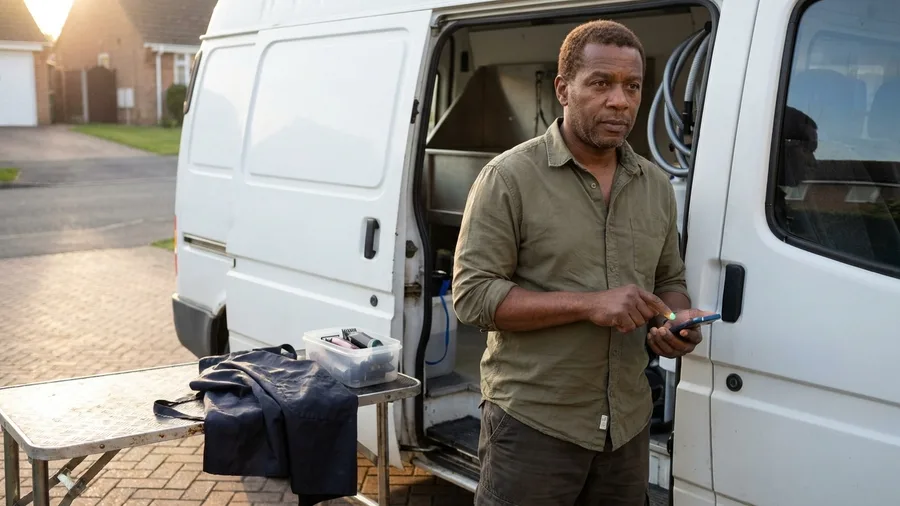
Strip the branding away and the product is three screens: a groomer's calendar, a card field for the deposit, and a text that goes out the night before.
Mobile dog groomers book a van slot, take a deposit so no-shows cost less, and get a reminder sent for them.
The $900,000 a month headline rests on 18,000 groomers each paying $50 monthly. That is a customer count, not a technology claim.
The app has no clever engine under the hood, just a schedule and a payment form that a groomer can run from the van between appointments.
The version in the one-day story runs in a browser on Lovable. There is no iPhone app and no Android app in that story, so a groomer opens a link on a phone.
The copyable part is the narrow job for one trade. The name and any general-purpose AI platform are not the business.
| Line | Monthly figure | What it leaves out |
|---|---|---|
| Subscribers | 18,000 paying | The years and channel it took to find them |
| Price | $50 per subscriber | Refunds and failed charges |
| Gross revenue | $900,000 | Payment processing and hosting |
| Builder plan | $25 (Lovable Pro) | Security review, support, six weeks of fixes |
| Profit | Not published | Everything that moves with revenue |
The one-day build was a prototype, not a launch

The stopwatch day was one 9-hour session on Lovable's $25 monthly plan. What went into the box was a single line asking for a groomer booking page, a deposit checkout and text reminders.
A structured prompt formula for AI answers is what keeps that single line specific enough to build from.
What came back was a working demo, fast enough to show someone that same evening.
The paying customer did not arrive that day. Six weeks of fixes came first: payment setup, support replies and the account edge cases the demo never touched.
A groomer who cannot reschedule a client, or whose deposit fails on a Saturday, does not renew in month two.
So the honest split is this. The prompt buys something you can show. The six weeks buy something a groomer will pay $50 a month to keep using. Budget both before you count a subscriber.
🛠️ From prompt to first paying customer
The build day
9 hours on the $25 plan, 5 free build credits a day if you test first, no code export on free.
Payment setup
Processor fees and deposit rules bill separately, so run test transactions before a real card is charged.
Edge cases
Double bookings, failed deposits and reminder timing each take a fix, and the fixes are what earn the renewal.
Security check
Keep secret keys out of the code and have someone who codes review login and payment handling first.
First customer
Six weeks after the build day, web-only on Lovable, which as of Oct. 17, 2026 cannot export the database.
The $900K comes from 18,000 $50 subscriptions

Every subscriber pays $50 each month, and 18,000 of those payments multiply out to $900,000. Nobody signs a large annual contract here. The figure is thousands of small renewals stacking up, which means one bad month shows up 18,000 times at once.
The multiplication is the easy part. Reaching 18,000 groomers is the whole job, and that number took a channel the demo does not show.
A solo builder should start from a count they can plausibly reach and a price they can defend, then work backward to a monthly figure.
Pick your price first. At $50, 100 subscribers is $5,000 a month. That math fits on a napkin, and it tells you how many sales calls sit between here and a living.
⚠️ COMMON MISTAKE
Copy the price, not the billboard
The $50 monthly price is part of the model and belongs in your first version. The $900,000 number is a result of 18,000 sales conversations and does not belong in your plan.
Support and refunds shrink the $900K month

The multiplication gets you to $900,000 a month, and none of it is profit yet. Refunds and payment processing both move with revenue, because the processor takes its cut on every charge and every refund reverses part of it.
The processor's own page holds the current rate, so check it there rather than anywhere else. Support is a monthly bill even when the app already works. The $25 builder plan is the smallest line on the sheet.
Hosting, processing and support are each billed by a separate provider, and each provider's page carries the rate that applies now. A number picked from a blog post or an old screenshot is a number that will be wrong.
The reserve: put money aside for refunds and support in the plan itself. That reserve is what decides whether the month covers itself, long before anyone hands in a notice at a job.
Build the plan around a customer count you can reach, subtract those three lines, and the $900K stops being a promise. It becomes a sum you can test on paper before you spend a single evening building.
Where the $900K lands, and what comes off it
Gross on the page
- 18,000 subscribers at $50
- $900,000 a month, before deductions
- No refund counted
- No processor fee counted
- No hosting or support cost counted
What leaves the account
- Refund reverses the charge
- Processor keeps a cut of every charge
- Refund still costs the fee
- Hosting billed monthly, users or not
- Support hours rise with subscribers
A one-day build leaves security for later

Budgeting for refunds keeps the books honest. It does nothing about the login screen, the checkout page or the customer records behind them, because none of that work shows up in a demo.
Veracode's 2026 report tested AI-written code against its security checks. The models passed 56% of the time, the same share as a year earlier. Roughly two attempts in five came back with a hole a stranger could walk through.
A nine-hour build never reaches those edges. Whoever signs in, who can see another groomer's bookings, what happens to a card number on its way to the processor: all of it sits outside the screen the builder was admiring.
The line: a demo and a product differ by one review, done before the first card is charged.
Charge a card through unreviewed checkout code and the exposure is the business itself, not a refund. Have someone who codes read the payment and sign-in paths first.
That review is the step that turns the demo you built in a day into something you can sell.
Builder plans, checked before you commit
Free tiers cap the test before it matters

A security review needs somewhere to run the fixes and a way to take the code with you afterward. On a free plan, both are decided before you type a word, and not always in your favor.
Lovable hands out 5 build credits a day on the free tier, and the code cannot leave the platform. Pay for one month of Pro and the download opens, so the app can be hosted elsewhere.
Bolt.new meters its free tier in tokens, with a daily cap that stops a long session midway. Pro runs $25/mo.
Replit's free tier publishes one app carrying a Made with Replit badge, and that free link goes dark after 30 days.
Quick check: before building, ask where the code goes after the demo and whether the published link survives the month.
Pick the free tier whose exit path matches where the finished app will live. The one that demos fastest can leave the review with nowhere to happen.
💡 PRO TIP
Test the exit on day one
Before you build anything real, export a throwaway project and open it on your own machine. If the files will not run or the database will not come with them, you have learned the most important thing about that builder for free.
Lovable, Bolt and Replit lock you in differently

Pick the builder by where the app can go later, not by how the demo looks on day one. On that test, Lovable is the most restrictive and Replit the most complete.
As of Oct. 17, 2026, Lovable produces web apps only, and there is no one-click way to move the database off it. The database is the stored customer records, bookings and deposits. That's the part your buyer data lives in, and it stays put.
One month of Pro at $25 lets you download the code to host elsewhere. The code leaves; the records do not. Anyone rebuilding the GroomFlow clone on Lovable should count that as a real exit cost before the first booking.
Bolt.new keeps it simple on price. Paid plans are Pro at $25 a month and Teams at $30 per member per month, listed in US dollars, with the free plan metered in tokens.
Replit Core is $20 a month, or $17 billed annually, and bundles hosting, databases and login handling. That bundle is the closest thing to an all-in-one for a non-coder, and the exit path is the one to check first.
Exit check: before you type the prompt, write down where the code and the customer records will live, and confirm the builder can move both.
The copyable version — at a glance
🎯 Audience
One trade, named
💵 Price
$50 per month
🌐 First build
Web app only
📋 Proof point
10 paying users
🗓️ Real timeline
6 weeks after demo
🔍 Before launch
Security review
The rule
A second feature waits until ten people are paying for the first one.
The demo is copyable; the distribution is not
The part you can see is the part everyone can copy. Anyone who opens the app sees the booking screens, the deposit field and the $50 monthly price. Reproducing those costs one prompt.
The 18,000 subscribers are a different asset. They came from a niche audience and a channel that never appears on screen. The copycat sees the finished app and cannot see where the buyers were found.
Builder lock-in is a code problem you can price. Distribution is the part the demo hides entirely, and a demo builds no trust with a mobile groomer deciding who holds her deposits.
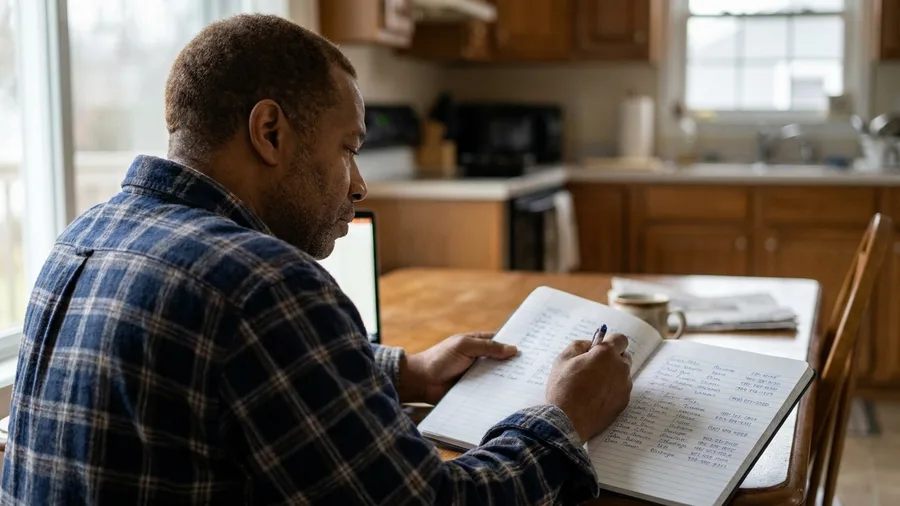
A list of groomers who already know your name does. Write that list first: 50 named mobile groomers, each with a name, a town and one reason they would pay $50. That happens before the builder is opened, not after.
Quick check: if you cannot name 50 buyers in one trade today, the prompt is not your bottleneck.
Copy the niche and the price, not the logo
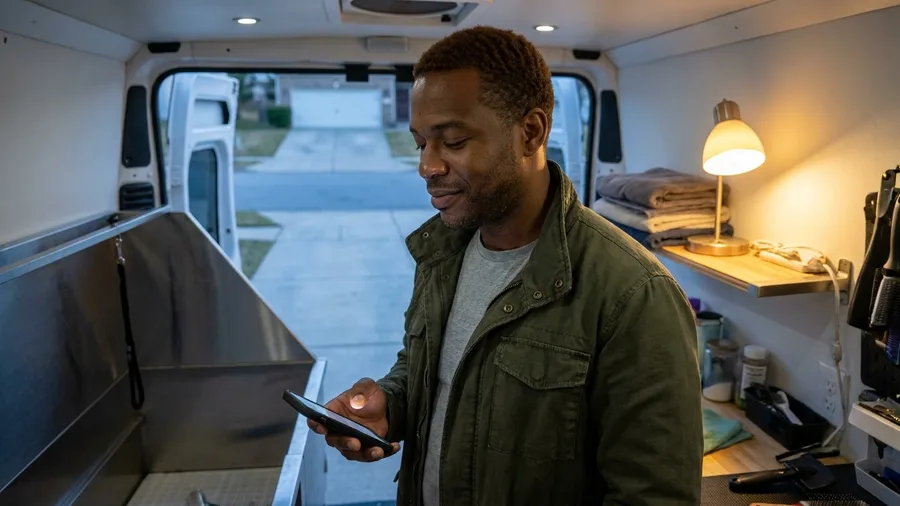
Take the shape, not the app. The repeatable play is one narrow audience with a recurring pain and a $50 monthly price. Grooming deposits are GroomFlow's pain; yours will be a different trade with a different recurring job.
Keep the monthly billing from day one. At $50 a month it takes 18,000 subscribers to reach $900,000, so a one-off price would break the model on the first slow month. The subscription is the mechanism, not a detail.
Keep the first version web-only. A browser app ships while a native iOS or Android version waits on app store review, and the first paying users should not wait on that.
Then stop building. The test is 10 paying users on the one trade, before a second feature is added. Ten payments tell you whether the price and the audience hold together, which no amount of added screens will.
Validation line: ten paying users on one workflow, then decide what comes next.
Sell it before you spend the day building

Ten conversations with mobile groomers come before any build. Ask each one how bookings arrive now, where the deposit gets taken and what happens when a client no-shows. Ten calls cover the same booking and deposit workflow ten times, and the pattern is the product.
Then ask for money before the app exists. A deposit or pre-payment from those ten is the only proof the price holds. Someone who will pay now is a customer; someone who says it sounds useful is a maybe.
Only after those conversations does the builder get opened. The free plan or the $25 monthly plan is there to demo the workflow that was just described back to the buyers, not to search for one.
By hand, ten interviews run about five hours of calling and notes. Writing up the pattern takes another hour. The demo after that is the same 9-hour session on Lovable, so the selling week comes first and the build day second.
Quick check: if the ten calls produce no deposit, the problem is the offer, not the app. Fix the offer before spending a day on screens, because a booking page nobody pays for is a free demo with your name on it.
The first step is a sales conversation. Ten named buyers, a deposit asked, and the answers written down decide what the demo needs to show before a single prompt is typed.
Frequently Asked Questions
Do I need to know how to code to copy this?
No, and that is why the story spread. Lovable, Bolt.new and Replit all build a working web app from a written description. You still need someone to check login, payments and stored client data before real customers use it, either you after some study or a developer you pay for a review.
Can I really get an app live for $25 a month?
The builder plan can be $25 a month. Hosting, payment processing and support are billed separately by other providers, and a security review costs either time or money. Treat $25 as the smallest line on the sheet, not the total.
Why does the revenue number say gross instead of profit?
Because refunds, processing fees, hosting and support come out before anything is left. A business at $900,000 a month in gross revenue could be losing money if support costs more than the subscriptions bring in. Ask for the net figure and watch what happens to the answer.
What happens if I want to leave Lovable later?
One month of Pro allows you to download the code and host it elsewhere. As of October 17, 2026, Lovable has no one-click way to move its database off the platform, so plan the customer records separately. Confirm the current export options on Lovable's own help pages before you build.
How long before the app makes money?
In the story behind this one, about six weeks passed between the build day and the first paying customer, and that was with a warm audience. Budget for a ramp where the first weeks bring little or nothing, and keep your day job until ten people are paying.
Is one trade too small a market?
One trade is the point. A narrow audience has one workflow, one vocabulary and one place to find them, so your sales conversations get easier with every call. Eighteen thousand mobile dog groomers turned out to be a $900,000-a-month market at $50 each.
Name fifty buyers before you open the builder
The $900,000 is a distribution story before it is a code story. Somebody found 18,000 mobile dog groomers and sold them a $50 monthly tool, and the one-day build was the easy part of that.
Your first move is a list: fifty named people in one trade, written down this week. Then sell ten of them before you build, and use the builder plan for the demo they already agreed to look at.
Copy the narrow trade, the $50 price and the web-first launch. Leave the gross revenue headline where you found it.